Total Pageviews

04 March 2017

No 18 POST – GREEN POINT LIGHTHOUSE

This is the oldest lighthouse in South Africa having been commissioned in 1824 and is now a National Monument. The purpose of the visit was twofold; to visit the headquarters of the Lighthouse and Navigation Services (LNS) business unit of Transnet and to obtain the proof photograph.

 
On arrival I met Ms Tasneem Jacobs who, amongst other functions, is responsible for the reservations of the four cottages available to the public. Reservations can be made by E mail at lighthouse.tourism@transnet.net or by phoning  021 449 2400. Having stayed at the Danger Point cottage, I can vouch for the high standard of this accommodation.
Green Point lighthouse also offers a self-conducted tour of the lighthouse for a small fee with very detailed returnable information sheets to illustrate and explain the structure and its exhibits. The beautiful wooden staircase (see below) is the original installation and the lead safety treads are unique. The thickness of the walls of the tower was striking, at minimum one metre. An open air viewing platform is accessible from just below the lantern house, (views below).


This lighthouse is at Mouille Point even though it called the Green Point lighthouse. It is very easily accessible from the beach road with adequate parking and was thus an easy tick in our quest.


No 17 POST – LESS ACCESSIBLE LIGHTHOUSES

John and I have just completed a short trip to view the lighthouses at,
·         Mouille Point (Green Point lighthouse),
·         Dassen Island,
·         South Head, Saldanha Bay and
·         North Head, Saldanha Bay.
The description “less accessible” is applied as special permission had to be secured from appropriate authorities to access the last 3 mentioned above. In fact, we were privileged to be able to access these sites and now record our thanks to the lighthouse personnel who assisted us. Individual posts follow.

Dassen Island :

 
South Head :
 
North Head :


06 December 2016

No 16 - CAPE INFANTA LIGHTHOUSE


No 16 POST – CAPE INFANTA LIGHTHOUSE
This lighthouse is inside the De Hoop Nature Reserve, so special arrangements had to be made to access the site. The De Hoop personnel were very helpful and we were permitted to travel on a sand and limestone track for 2 hours (37 km) to reach the lighthouse. The last few kilometres is heavily overgrown with rooikrans. The first view was thus a relief.


It was a beautiful, windless day for the culmination of our trip.


The return trip was faster taking 11/2 hours. There is a shorter route from the village of Infanta, but because of 2 sets of locked gates, one would probably need the assistance of the lighthouse personnel.

The lighthouse is actually sited on Uiterstepunt which is West of Cape Infanta. This was originally privately owned property which was expropriated by Armscor, later Denel. The land is still owned by Denel, but custodianship has been granted to Cape Nature. The actual Cape Infanta point is very close by and was photographed in the afternoon sun.
 

05 December 2016

No15 POST – STRUISPUNT LIGHTHOUSE


No15 POST – STRUISPUNT LIGHTHOUSE
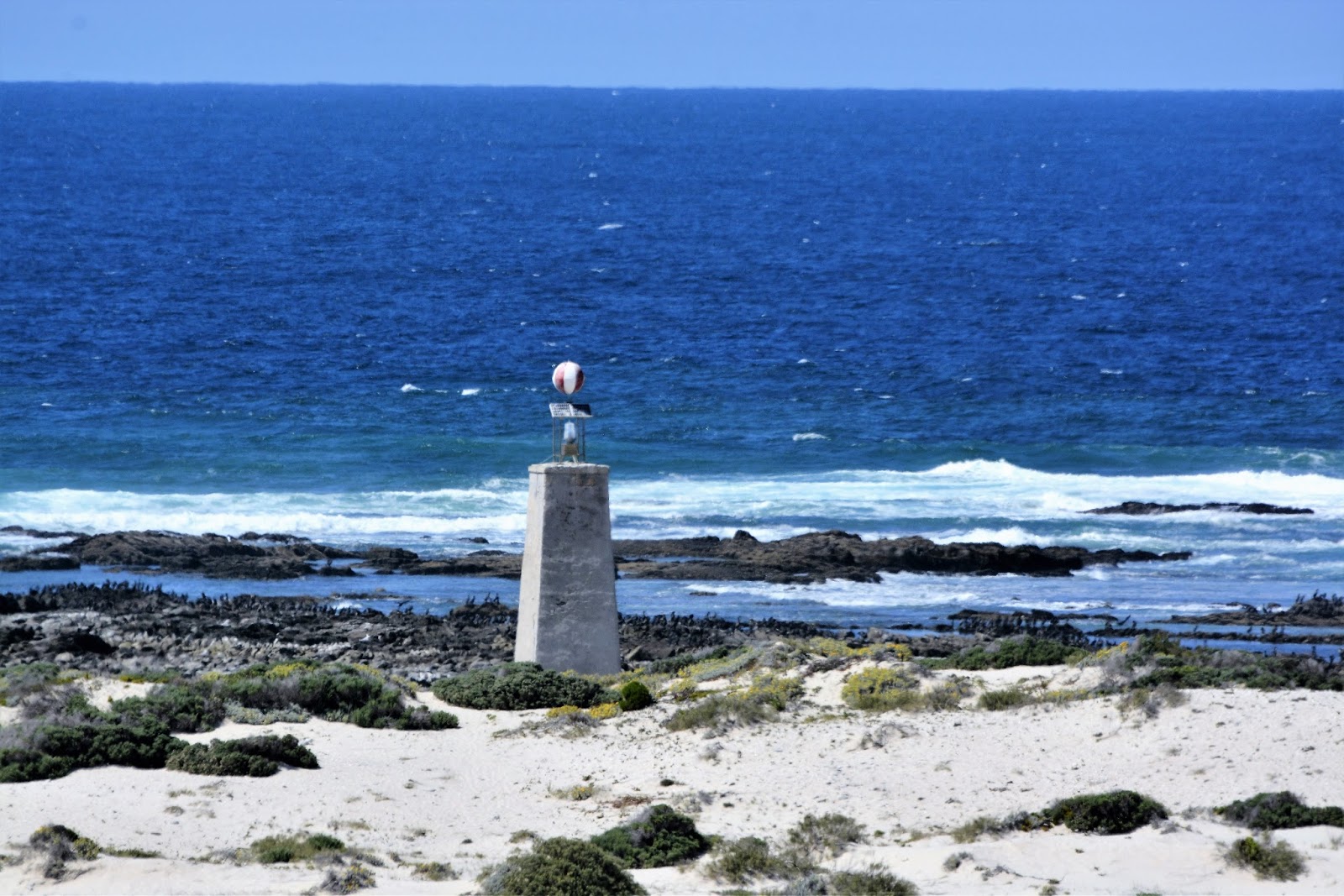
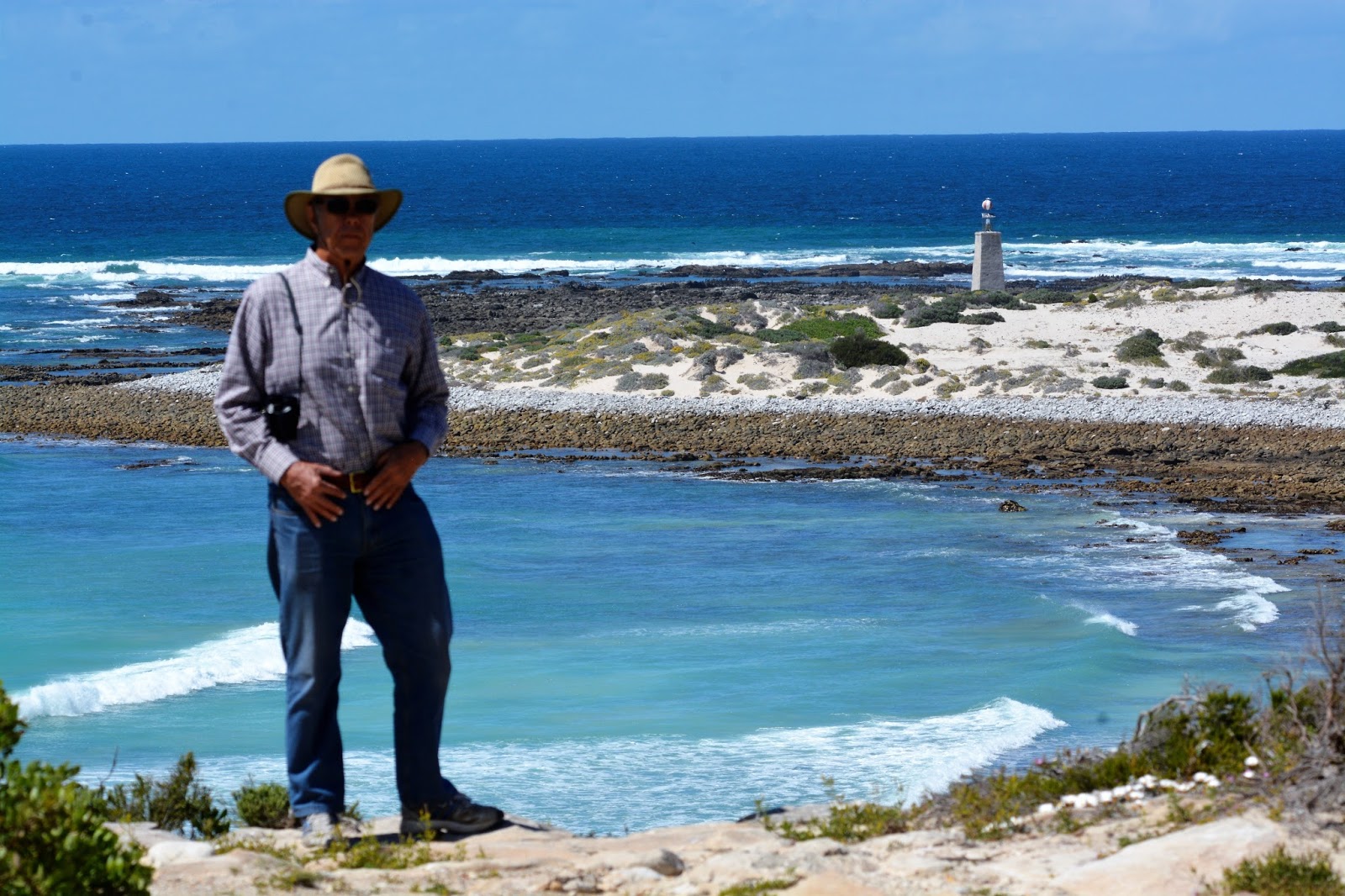
This lighthouse is a minor light, sometimes referred to as the beacon (die baaken) by the locals. It is not listed on the official Transnet list of 45 lighthouses. It is a concrete structure with a light that was only recently installed. It warns of the extensive Bulldog Reef that extends off to the South-east.


The access road to the South-west of Arniston is of limestone and sand. The latter is liable to be blown away thus affecting the condition of the road. During our visit it was impassable at the steep section descending from the cliffs to the point.


While in this area one should visit THE cave which is accessed from this final parking area. There are many other smaller caves under the cliffs before reaching this point.

04 December 2016

No 14 POST – CAPE AGULHAS LIGHTHOUSE


No 14 POST – CAPE AGULHAS LIGHTHOUSE
A lighthouse at the Southern tip of Africa is what the early mariners needed. This is it, where the Indian and Atlantic oceans meet. It was built from locally hewn limestones blocks in 1848, largely at the insistence of the public. Today it is a national monument and in good condition, as seen in the views from the land side and sea side.


Hold your hat, as the wind is still blowing. High seas and strong winds all along this Southern coastline explain the high number of wrecks. A more recent one is the Meisho Maru, a Japanese fishing vessel, which came ashore in 1982. The bow section is still standing and is much photographed by the tourists. All 17 seamen managed to swim ashore.


This area is well frequented by tourists, so there is plenty of accommodation. We stayed in one of the SANP chalets, all of which have a seaview. A must of course, for all tourists, is a photograph at the Southernmost point of the continent.


The lighthouse is open to the public for a small fee. After a steep climb, there are good views from an outside walkway below the light. Tidal fish traps are visible to the East. While at the lighthouse many visitors miss two interesting features.

The grave of Daisy Rowe is in the island in the car park. She was the daughter of the lighthouse keeper and died of diptheria. Her exact date of passing is uncertain, as the tombstone and the cross show different dates.
There is also a small cave in the limestone just to the West of the lighthouse.

When one is in the area, a visit to the Shipwreck Museum in Bredasdorp is certainly worthwhile.


No 13 POST – QUOIN POINT LIGHTHOUSE


This lighthouse is in the Walker Bay Nature Reserve, but there are no gates to hinder access. It is visible at the turnoff off the road to Buffeljachts and is accessed along 5 km of difficult sand and limestone road. It is unmanned.


Contractors were laying paving around the lighthouse and adjacent accommodation for lighthouse maintenance staff and equipment, during our visit.


The final approach to the beach was across a beach. The houses at Quoin Point were built by the descendants of two families who regularly assisted survivors of shipwrecks on this dangerous section of coastline. As a reward the families were granted the right of use of this area and no doubt creating an obligation to assist future unfortunate seafarers, or maybe fortunate, to have survived !


03 December 2016

No12 POST – DANGER POINT LIGHTHOUSE

Danger Point lighthouse is situated at the tip of a peninsula and associated with the unfortunate loss of the Birkenhead. The closest town is Gansbaai at the base of the peninsula. This is a magnificent lighthouse and in very good condition. Views are in the afternoon sun and the following morning.
 

The “museum” within the tower houses the various types of light used since inception in 1895. Initially pressurised paraffin combusted through a mantle producing the light, but this was replaced in 1937 by a 4000 watt electric globe powered from a diesel driven generator. The power source was changed to Eskom in 1970 and the wattage could be reduced to 1500 and later to a 400 watt metal halide lamp.


The traditional system of descending weights to operate the rotating light has been replaced by small electric motors.

 
Certain lighthouses offer accommodation and we stayed here overnight. Our host was Robin and the 3 bedroomed accommodation is highly recommended and is well furnished. Anyone wishing to reserve this accommodation should book through Tasneem at 021 449 2400 or E mail to lighthouse.tourism@transnet.net .


The Birkenhead Memorial, commemorating the loss of 445 souls, is a plaque set in a waist high concrete base. A groove in this base is lined up with the Birkenhead rock where the swell breaks on occasion. This was the case the next morning. The rock itself is below water level and about 2 km offshore. 


This smaller plaque is set into the wall of the lighthouse.


The seaside resorts of Kleinbaai and Franskraal are also on the peninsula.
Kleinbaai is the base of the shark cage diving industry as it is the closest harbour to Dyer Island which is frequented by Great White sharks because of its seal population. It is amazing how this industry has grown so rapidly.
 
 
The Strandveld Museum houses Oom Jan’s private collection of memorabilia and this is to found at Franskraal.


20 November 2016

No 11 POST – HANGKLIP LIGHTHOUSE

This lighthouse is on the Eastern point of False Bay near Cape Town and was built in 1958.


We could not get close to the lighthouse due to a locked gate and being a very windy and cold day we decided not to walk the estimated 400 metres to it. This picture was taken from the boat launching slip on Maasbaai.


A baboon (extreme right below) was very curious, but nonchalantly kept his distance when we approached.


Anyone visiting this area should take the trouble to visit the nearby Stoney Point nature reserve. This is one of only two continent based Jackass Penguin breeding colonies in the World. It is occasionally ravaged by a leopard coming down from the mountainside.


This area was also a whaling station in years gone by and the remains of a whaler can be seen in what was the harbour.
 
Moving into the reserve one can observe more penguins, other sea birds and white horses! The latter behind the man made structure confirms the wind mentioned earlier.


The background to this structure is explained. I guess we can’t count this as one of the 45 we hope to visit.

Parents and babies confirm that this area is a breeding sanctuary.